
Enzymes are nature’s biological catalysts that constitute a type of protein and can facilitate highly chemical reactions crucial to living organisms thus making life possible. Be it the digestion of food or the replication of DNA, enzymes are the driving forces behind all such processes. In this article, we shall discuss what enzymes are, the work they do, and their believed indispensable role in the body of the human being.
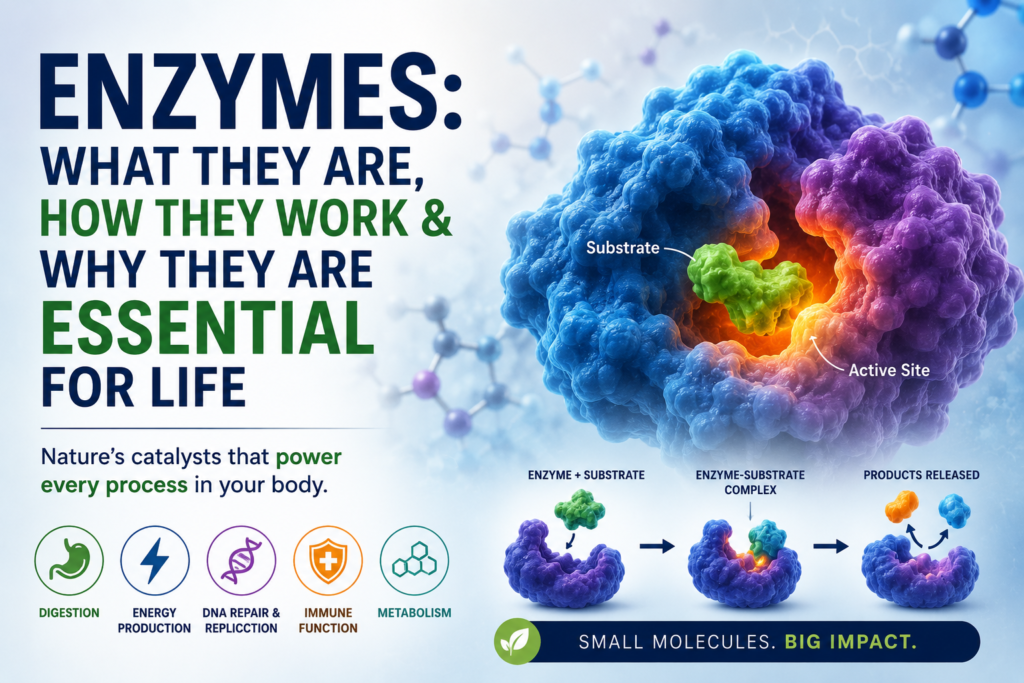
What Are Enzymes?
Enzymes are proteins that accelerate chemical reactions utilizing reducing the activation energy which is the energy needed to start a reaction to its required level for the reactions to take place. This is what processes that can last for hours or days happening in a few seconds with the aid of enzymes means it can.
What are enzymes and how do they work?
Enzymes are essentials of life according to the fact, they are the ones who help cells to grow and, they are the ones who break down the molecules which are excess in the cells. In addition, if enzymes are not there, our bodies are not able to perform the basic chemical reactions and therefore it means we cannot grow and or repair or cleanse our bodies without chemical help. Without enzymes, our bodies would not be able to perform the basic chemical reactions needed for growth, repair, and everyday function.
The Mechanism Behind Enzyme Action
The Lock and Key Model
One way of understanding enzymes that is not so complicated should be done by taking the example of the lock and key model. In this case, the entirety of the process becomes a kind of metaphor, where the enzyme is the “lock”, and the “key” in this configuration is the substance under the influence of the enzyme.
- Active Site: the main enzyme called the active site is the location with which the substrate connects. This place has the proper shape thus only certain substrates are compatible with the enzyme, hence the enzyme exclusively cogitates on the right molecule.
- Enzyme-Substrate Complex: As a result of the substrate’s accommodation to the active site, they join together impermanently. The enzyme, in turn, assists in changing the substrate to a different kind of molecule, which is the product.
- Release of Product: The enzyme now reverts the process and lets the product go and so becomes available to accept another substrate.
This extremely particular procedure guarantees that every enzyme only catalyzes one type of reaction, which is very important to the effective operation of our cells.
The Induced Fit Model
More latest models, like the induced fit model, show that the active site of an enzyme is not rigid but flexible. When the substrate comes, the enzyme alters its form slightly to achieve a better fit. This modification not only strengthens the binding but also optimizes the chemical reaction.
Why Enzymes Are Essential for Life
In the human body, enzymes perform a variety of important tasks. Their significance in nearly every biological process can be observed:
1. Digestive Enzymes: Breaking Down Food
During the process of eating, your body will use enzymes to digest and absorb nutrients.
- Amylase: Amylases can be found in saliva as well as in pancreatic juice, they are responsible for converting carbohydrates into glucose.
- Protease: Proteases are responsible for breaking down proteins into amino acids that can be used to rebuild tissues and produce hormones by the body
- Lipase: Lipases are enzymes that help the digestion of fats into their parts which are fatty acids and glycerol making it easier to use those fatty acids for energy.
If these enzymes did not exist, food would be digested but the body’s cells would not be able to use it.
2. Metabolic Enzymes: Powering Cellular Reactions
The chemical reactions of each cell in your body are dependent on metabolic enzymes for their normal operation.
- Energy Production: The conversion of nutrients into the energy currency of the cell, ATP (adenosine triphosphate), occurs through enzymatic processes, such as glycolysis and the citric acid cycle.
- Biosynthesis: Enzymes are the molecules that constitute nucleotides, lipids, and proteins, which are very much necessary for cell repair and growth.
- Detoxification: In the man’s liver certain enzymes convert toxins into innocent things that can be easily removed via stools.
All of these actions (that contribute to the metabolism of the cell) would not proceed without enzymes, and the enzymes catalyze the reactions without being affected by them.
3. DNA Replication and Repair
Cell reproduction, as in the process of mitosis, contains catalysts like DNA polymerases that produce an identical copy of the DNA encapsulating the genetic material correctly. Furthermore, they regulate that every new cell gets all the necessary data to develop, heal, and/ or reproduce.
- DNA Repair Enzymes: Because DNA repair enzymes work constantly and analyze the mistakes in the DNA, resulting in the creation of mutations, such as cancer, they protect us from cancer.
4. Immune Function
- The immune system also reinforces its task with enzymes. For example, white blood cells’ enzymes disintegrate pathogens that are entering the organism. It avoids attacks from bacteria or viruses and consequently health is being protected by this.
Factors Affecting Enzyme Activity
Enzymes that are very effective in the transformation of one compound to another are influenced by several factors. It is crucial for both biology and medicine that these factors be well understood.
Temperature
Enzymes display the most positive results at a temperature that is optimal for them. As for most human enzymes, the chief operator of enzymes for humans is a value near 37°C (98.6°F).
- Too Low: Where there is a very low temperature, the decrease in enzyme activating rate is the cause of the tissues because they cannot hold the evolving internal temperature.
- Too High: Enzymes’ presence in large volume with substantial degree rivals the heating to lead to their deformation; therefore, it may be the cause of their non-functionality.
pH Levels
Enzyme activity is also dependent on the right range of pH. For instance, when digestive enzymes are found in the stomach they perform the best in a highly acidic environment (very low pH 1.5 to 3.5) and enzymes function properly in the small intestine when the pH is slightly alkaline (near 7-8).
- Acidic or Alkaline Shifts: Changes in pH away from the optimum can cause damage to the enzyme structure, thereby interfering with metabolism and digestion.
Enzyme Concentration
The concentration of enzyme molecules can impact the speed of reactions. As the concentration of the enzyme increases, the speed of the reaction increases until the substrate becomes the limiting factor.
Presence of Inhibitors
A few chemicals can hinder the reactions that the enzyme catalyzes by either binding to the active site or other areas of the enzyme. The reversible or irreversible inhibitors can both affect the excitatory reactions of the biopolymers of enzymes and they are also the means of metabolic pathway regulation.
- Competitive Inhibitors: They are substrates that resemble the substrate and thereby compete for the active site.
- Non-Competitive Inhibitors: They are those that bind to another location different from that of the enzyme, thus changing the form and the role of the enzyme.
Types of Enzymes in the Human Body
Enzymes can be classified based on the type of reaction they catalyze:
1. Oxidoreductases
These enzymes promote oxidation and reduction reactions. Energy production and metabolic functions heavily depend on them.
- Example: The energy production process during cellular respiration is carried out by dehydrogenases which transform substrates into energy.
2. Transferases
Transferases move functional groups from one molecule to another, which is essential in metabolism.
- Example: Aminotransferases help in the metabolism of amino acids by transferring amino groups.
3. Hydrolases
Hydrolases catalyze the cleavage of bonds by adding water. They are crucial for digestion.
- Example: Lipase, amylase, and protease fall under this category, breaking down fats, carbohydrates, and proteins, respectively.
4. Lyases
Lyases break bonds without water and are important in metabolic pathways such as the synthesis of new molecules.
5. Isomerases
These enzymes are responsible for changing the arrangement of a compound’s atomic structure and they are important in the metabolism of the compound and the release of the metabolic product.
6. Ligases
Ligases are a type of enzyme that binds two molecules together, which is a significant activity in DNA repair and replication.
Enzymes in Everyday Life and Health
Digestive Health
Your digestive system is the most enzyme-populated area of your body. Enzymes reduce the food you eat so that it can be utilized by our body as nutrients.
- What enzymes break down food? Enzymes for digestion are an indispensable part of your body that can`t use the nutrients from the food without them.
Sports and Fitness
Athletes often place a lot of emphasis on enzyme function as well as on the enzymes that play a critical role in energy production and muscle healing.
- Example: Enzymes such as lactate dehydrogenase convert lactate into energy during intense exercise, which affects muscle recovery strength, and fatigue, leading to more successful workouts.
Medical Applications
Advanced research on enzymes has resulted in various medical advances. By using enzyme inhibitors, drugs that can cause therapies for diseases such as hypertension, cancer, and diabetes can be easily developed.
- Example: ACE inhibitors are those drugs that specifically block an enzyme responsible for increasing blood pressure, thus allowing the body to control hypertension better.
Industrial Uses
Moreover, apart from human health, enzymes are being extensively utilized in other aspects of life like the manufacturing of food products or bioplastics. They help dissolve hard-to-process materials which leads to more efficient and less harmful processes to the environment.
Common Myths and Facts About Enzymes
Myth 1: Enzymes Are Only Important for Digestion
Fact: Even though digestive enzymes are crucial, enzymes participate in almost all biochemical processes. They range from DNA replication to immune responses in the body.
Myth 2: You Can’t Improve Your Body’s Enzyme Function
Fact: The body can be improved through a balanced diet rich in nutrients and exercise which can help to retain active enzyme levels like vital substances that support total wellness.
Myth 3: All Enzymes Work the Same Way
Fact: Enzymes are very specific. Instead, each enzyme is tailored to a particular reaction, which is why your body has over a hundred distinct enzymes.
Key Takeaways
- Enzymes are proteins that cause reactions to speed up.
- They do it by bringing down the energy necessary to activate the reaction, thus ensuring that life-sustaining processes take place effectively.
- Enzymes are crucial for such processes as digestion, metabolism, DNA replication, immune function, and many others.
- Enzyme activity can be influenced by such factors as temperature, pH, enzyme concentration, and inhibitors.
- Enzymes are also sub-categorized according to the types of reactions they catalyze, so each one serves a specific function that is necessary for being healthy.