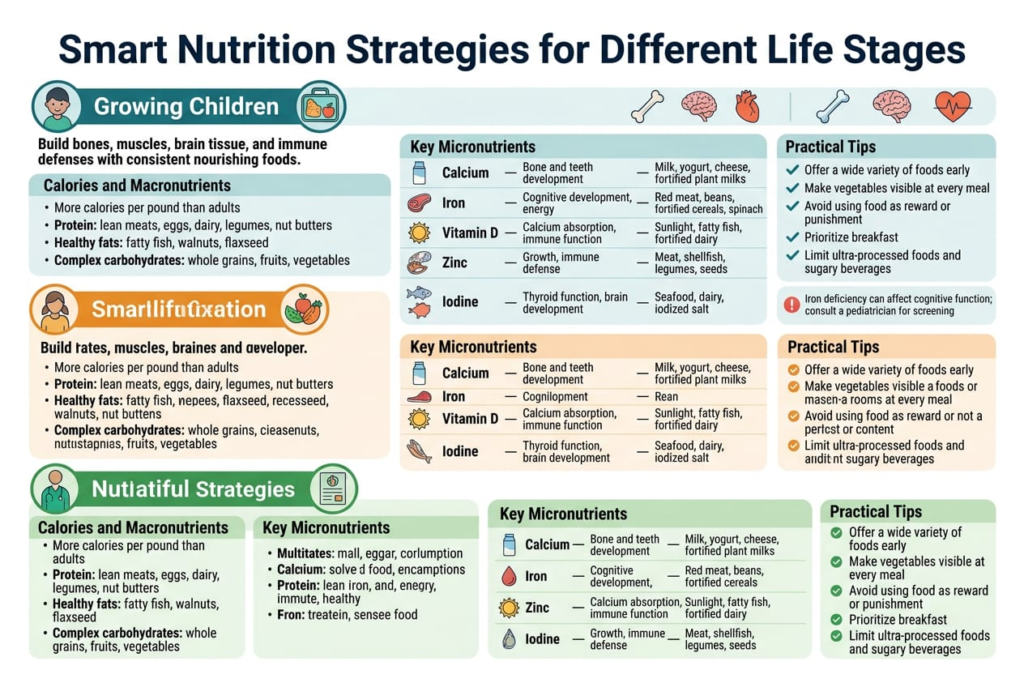
Meeting the Nutritional Needs of Growing Children
Kids are in a constant state of building — bones, muscles, brain tissue, immune defenses — and what they eat during these early years has a direct impact on how well that construction project goes. The goal isn’t perfection at every meal; it’s about creating a consistent pattern of nourishing foods that support their rapid growth.
Calories and Macronutrients
Children need more calories per pound of body weight than adults do, especially during growth spurts. But those calories need to come from quality sources, not just anything that fills them up.
- Protein is non-negotiable. It supports muscle development, immune function, and enzyme production. Lean meats, eggs, dairy, legumes, and nut butters are all great options.
- Healthy fats — especially omega-3 fatty acids from fatty fish, walnuts, and flaxseed — are critical for brain development and cognitive function during childhood.
- Complex carbohydrates from whole grains, fruits, and vegetables provide steady energy for active bodies and growing brains.
Key Micronutrients for Children
| Nutrient | Why It Matters | Top Food Sources |
| Calcium | Bone and teeth development | Milk, yogurt, cheese, fortified plant milks |
| Iron | Cognitive development, energy | Red meat, beans, fortified cereals, spinach |
| Vitamin D | Calcium absorption, immune function | Sunlight, fatty fish, fortified dairy |
| Zinc | Growth, immune defense | Meat, shellfish, legumes, seeds |
| Iodine | Thyroid function, brain development | Seafood, dairy, iodized salt |
Iron deficiency is one of the most common nutritional issues in children and can quietly affect attention span and school performance long before any obvious symptoms show up. If a child is a picky eater or follows a plant-based diet, it’s worth talking to a pediatrician about whether supplementation is needed.
Practical Tips for Feeding Kids Well
- Offer a wide variety of foods early on — repeated exposure to different flavors and textures helps children develop broader food preferences over time.
- Make vegetables visible and normal at every meal, even if they go untouched at first. Research shows it can take 10 to 15 exposures before a child accepts a new food.
- Avoid using food as a reward or punishment, which can create unhealthy emotional relationships with eating.
- Prioritize breakfast. Children who eat breakfast consistently tend to have better concentration, memory, and academic performance.
- Limit ultra-processed foods, sugary beverages, and fast food not because they’re forbidden, but because they crowd out more nutrient-dense options.
How Teenagers Can Fuel Performance and Development
Adolescence is one of the most nutritionally demanding periods in a person’s life. Teens go through dramatic physical changes, hormonal shifts, increased athletic demands, and major cognitive development — often all at the same time. On top of that, they’re navigating social pressures around food that can pull them in really unhealthy directions.
Caloric and Protein Needs Spike During Teen Years
A teenage boy who plays sports might need anywhere from 3,000 to 4,000 calories per day. A teenage girl going through puberty needs significantly more energy than she did just a few years earlier. The problem is that many teens are either undereating because of body image concerns or filling those calorie needs with low-quality food.
Protein needs increase sharply during adolescence:
- Teen boys: approximately 52–59 grams per day (more if they’re athletic)
- Teen girls: approximately 46–52 grams per day
- Athletic teens of either sex may need 1.2–1.6 grams per kilogram of body weight
Protein supports muscle growth, tissue repair, and the synthesis of hormones that are actively reshaping the body during these years.
Bone Health Is a Window That Won’t Stay Open Forever
About 90% of peak bone mass is accumulated by age 18 in girls and age 20 in boys. After that, the window for building dense, strong bones essentially closes. This makes calcium and vitamin D intake during the teen years genuinely critical — not just good practice.
- Calcium goal: 1,300 mg per day for teens (the highest of any life stage)
- Vitamin D goal: 600 IU per day, though many experts suggest higher amounts are better
Dairy products, fortified plant milks, leafy greens like bok choy and kale, and canned fish with bones are all solid sources.
Iron and Teen Girls
Once menstruation begins, iron needs jump. Teen girls need about 15 mg of iron per day, and many fall well short of that. Signs of iron deficiency — fatigue, poor concentration, reduced athletic performance — are easy to mistake for regular teenage exhaustion. Pairing iron-rich foods with vitamin C sources dramatically improves absorption.
Iron-rich food combinations:
- Lentil soup with a squeeze of lemon
- Spinach salad with strawberries and sunflower seeds
- Chicken stir-fry with bell peppers over brown rice
Nutrition for Teen Athletes
Teen athletes have a layer of extra complexity — they need enough fuel to support both growth and performance, and under-fueling is a real and damaging problem in this group.
- Carbohydrates are the primary fuel for high-intensity exercise. Low-carb approaches are generally not appropriate for teens in active training.
- Hydration matters more than most teens realize. Even mild dehydration (1–2% of body weight) can reduce strength, speed, and decision-making ability.
- Timing matters: Eating a carbohydrate-rich meal or snack 1–2 hours before training and a protein-carbohydrate combination within 30–60 minutes after training supports performance and recovery.
Navigating Social Pressures and Disordered Eating
Teens are surrounded by diet culture, social media images, and peer pressure that can make healthy eating complicated. Disordered eating patterns — including restriction, binge-restrict cycles, and excessive food rules — often start during adolescence.
Parents and caregivers play a meaningful role here. Talking about food in terms of energy, strength, and health rather than weight and appearance sets a much more supportive tone. Creating family meals where all foods are treated with a relaxed attitude helps teens develop a healthier relationship with eating long-term.
Key Dietary Adjustments That Benefit Adults Over 50
After 50, the body’s nutritional needs shift in ways that often catch people off guard. Metabolism slows down, muscle mass declines more rapidly, nutrient absorption becomes less efficient, and the risk profile for chronic diseases changes significantly. The good news is that targeted dietary adjustments can genuinely slow these processes and support a high quality of life well into later decades.
Protein Needs Actually Go Up, Not Down
One of the most misunderstood aspects of aging nutrition is that older adults need more protein, not less. Sarcopenia — the gradual loss of muscle mass that accelerates after 50 — is one of the biggest predictors of reduced mobility, falls, and loss of independence in later life. And it’s largely preventable with adequate protein intake and resistance exercise.
Protein recommendations for adults over 50:
- General recommendation: 1.0–1.2 grams per kilogram of body weight per day (compared to 0.8 g/kg for younger adults)
- Older adults who are active or recovering from illness: up to 1.5 g/kg per day
- Spread protein across meals — aim for 25–40 grams per meal rather than loading it all at dinner
Leucine, an amino acid particularly abundant in dairy, meat, and eggs, is especially effective at triggering muscle protein synthesis in older adults.
Nutrients That Become More Critical After 50
| Nutrient | Why It Matters More After 50 | Practical Sources |
| Calcium | Bone density loss accelerates, especially post-menopause | Dairy, fortified milks, sardines, tofu |
| Vitamin D | Skin produces less with age; deficiency is extremely common | Fatty fish, eggs, sunlight, supplements |
| Vitamin B12 | Stomach acid decreases with age, reducing absorption from food | Animal products, fortified foods, supplements |
| Magnesium | Supports sleep, blood sugar regulation, and heart rhythm | Nuts, seeds, leafy greens, legumes |
| Potassium | Helps manage blood pressure, which tends to rise with age | Bananas, sweet potatoes, beans, avocado |
| Omega-3 Fatty Acids | Supports heart health, brain function, and inflammation management | Fatty fish, walnuts, flaxseed, fish oil |
Vitamin B12 deserves special attention here. After 50, reduced stomach acid production makes it harder to extract B12 from food, even if intake is adequate. Supplemental B12 in crystalline form (found in fortified foods and supplements) bypasses this problem entirely and is well-absorbed regardless of stomach acid levels.
Managing Caloric Needs While Maintaining Nutrient Density
Caloric needs decline by roughly 200–300 calories per decade after middle age, largely because of reduced muscle mass and lower activity levels. But nutrient needs don’t drop at the same rate — and in some cases, they go up. This creates what nutrition researchers call the “nutrient density gap,” where older adults need to get more nutritional value from fewer calories.
Strategies to close that gap:
- Replace refined grains with whole grains — same calories, far more fiber, vitamins, and minerals
- Build every meal around a quality protein source first, then fill in with vegetables and complex carbs
- Choose calorie-dense-but-nutrient-poor foods (chips, pastries, sugary drinks) only occasionally
- Use healthy fats like olive oil, avocado, and nuts to add nutrients and satiety without empty calories
- Eat plenty of deeply colored vegetables and fruits — these are among the most nutrient-dense foods per calorie available
Gut Health and Digestion After 50
Digestive efficiency often decreases with age. Gastric motility slows down, beneficial gut bacteria populations shift, and many older adults experience increased constipation and bloating. Prioritizing fiber — particularly from a mix of soluble and insoluble sources — supports regular digestion and feeds beneficial gut bacteria that influence everything from immune function to mood.
- Soluble fiber (oats, beans, apples, flaxseed) helps manage blood sugar and cholesterol
- Insoluble fiber (whole wheat, vegetables, nuts) supports bowel regularity
Adequate hydration amplifies fiber’s benefits. Dehydration is surprisingly common in older adults because the sensation of thirst becomes less reliable with age. Drinking water consistently throughout the day — rather than waiting until thirsty — is a simple habit with meaningful health benefits.
Bone Health Strategies Beyond Calcium
Bone loss is a major concern after 50, particularly for women post-menopause. Calcium alone isn’t the full answer.
- Vitamin K2 directs calcium into bones rather than soft tissues — found in fermented foods, aged cheese, and certain leafy greens
- Magnesium is required for vitamin D activation and bone mineralization
- Weight-bearing exercise alongside adequate nutrition is one of the most powerful tools for maintaining bone density
- Limiting alcohol and avoiding smoking both have direct negative effects on bone density
A bone density scan (DEXA scan) is recommended for women at 65 and men at 70, or earlier if risk factors are present. Knowing where you stand allows for smarter, more targeted nutritional and medical decisions.