
Introduction
Vitamin B1, also called thiamine, is a water-soluble B vitamin that has a central role in cellular energy metabolism (Schostak et al., 2023). Although the vitamin itself is relatively small, its active form participates in several reactions that allow cells to extract energy from carbohydrates, amino acids and other metabolic fuels.
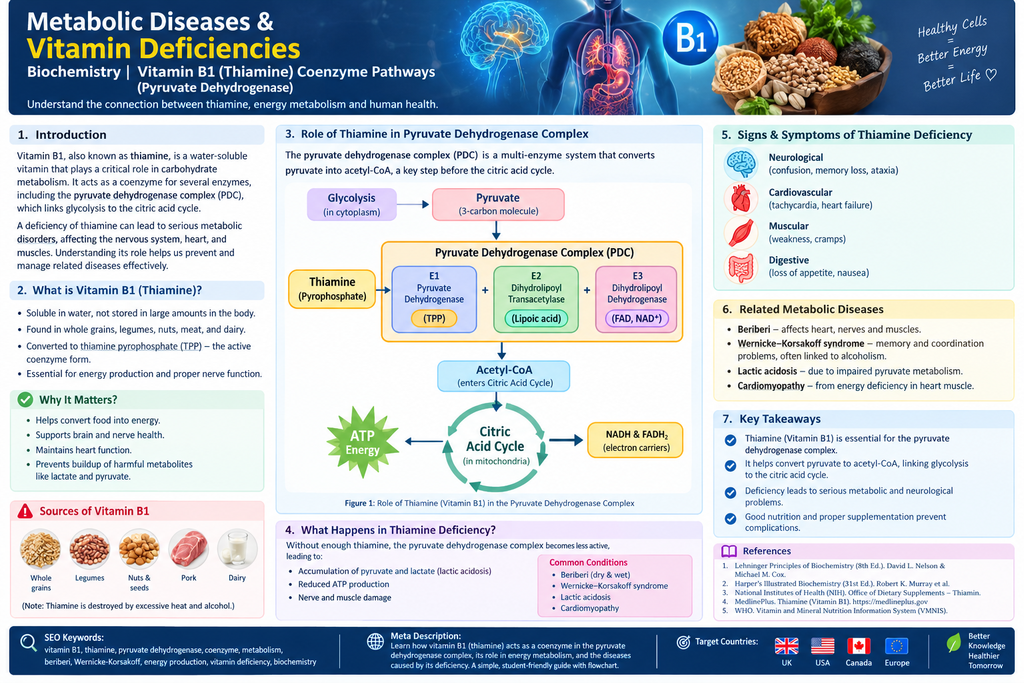
One of the most important examples is the pyruvate dehydrogenase complex (PDC).
For a biochemistry student, the relationship can be remembered in one simple sequence:
Vitamin B1 → Thiamine pyrophosphate (TPP) → Pyruvate dehydrogenase → Acetyl-CoA → Citric acid cycle → ATP production
The connection is important because glycolysis produces pyruvate in the cytoplasm, while the citric acid cycle operates in the mitochondrial matrix. The pyruvate dehydrogenase complex provides the major biochemical link between these stages of glucose oxidation.
When thiamine is deficient, this pathway can become impaired. The consequences can extend beyond energy metabolism and contribute to neurological and cardiovascular disease, particularly in severe deficiency.
1. What Is Vitamin B1?
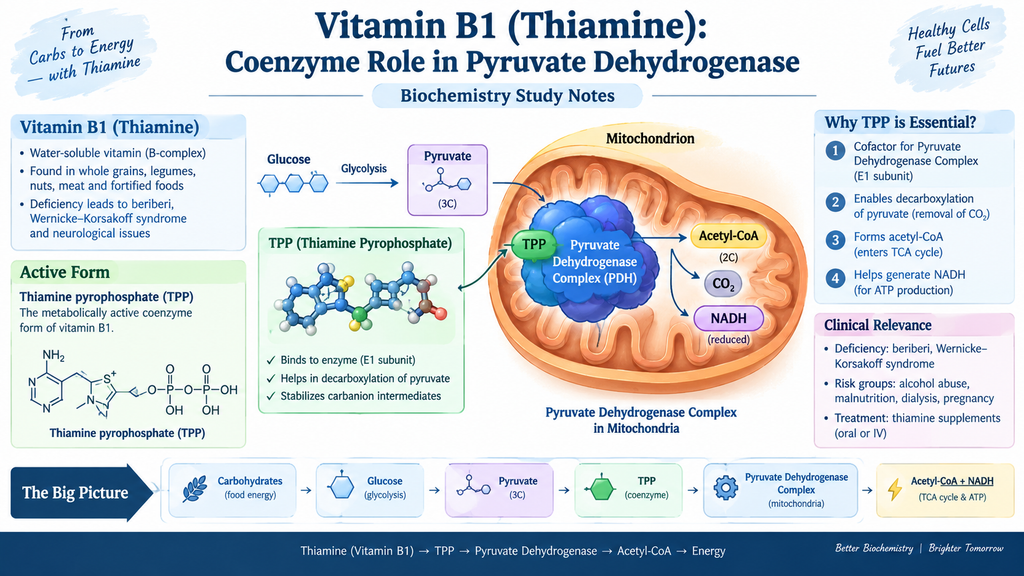
Vitamin B1 is the common name for thiamine.
It is a water-soluble vitamin belonging to the B-complex family. Because the body stores only relatively small amounts of thiamine and its half-life is short, a regular dietary supply is required.
Thiamine is naturally found in foods such as:
- Whole grains
- Legumes
- Nuts and seeds
- Meat
- Fish
- Some fortified foods
The vitamin is particularly important for pathways involved in:
- Carbohydrate metabolism
- Amino-acid metabolism
- Energy production
- The pentose phosphate pathway
- Normal nervous-system function
Approximately 80% of the thiamine present in the adult body is found as thiamine diphosphate (TDP), also commonly called thiamine pyrophosphate (TPP) . TDP/TPP is the major metabolically active form.
2. From Thiamine to TPP: Activation of Vitamin B1
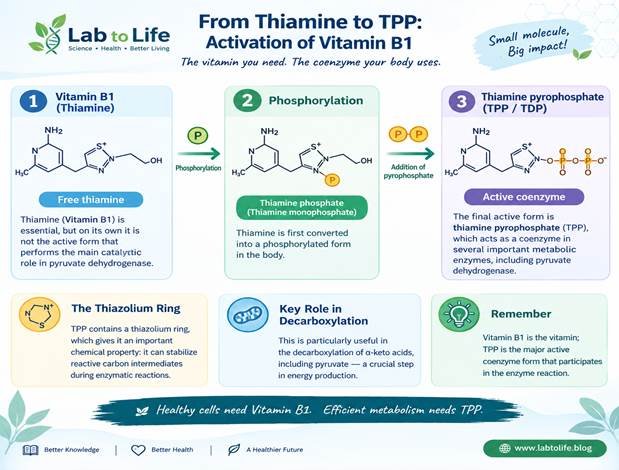
Free thiamine is not the form that performs the main catalytic role in pyruvate dehydrogenase.
It must first be converted into a phosphorylated form.
Simplified activation pathway
Thiamine (Vitamin B1)
↓
Phosphorylation
↓
Thiamine pyrophosphate / thiamine diphosphate (TPP/TDP)
↓
Active coenzyme
TPP contains a thiazolium ring, which gives it an important chemical property: it can stabilize reactive carbon intermediates during enzymatic reactions.
This is particularly useful in the decarboxylation of α-keto acids, including pyruvate.
Vitamin B1 is the vitamin; TPP is the major active coenzyme form that participates in the enzyme reaction (Huang et al., 2026).
3. Why Is TPP Biochemically Important?
TPP is a cofactor for several enzymes involved in central metabolism.
The major TPP-dependent enzyme systems include:
| Enzyme | Main metabolic role |
| Pyruvate dehydrogenase complex | Pyruvate → acetyl-CoA |
| α-Ketoglutarate dehydrogenase complex(Mrowicka et al., 2023) | α-Ketoglutarate → succinyl-CoA |
| Branched-chain α-ketoacid dehydrogenase complex | Branched-chain amino-acid metabolism |
| Transketolase | Pentose phosphate pathway |
| 2-Hydroxyacyl-CoA lyase 1 | Certain fatty-acid α-oxidation reactions |
The first four are particularly important for undergraduate biochemistry. TPP therefore connects vitamin B1 with carbohydrate metabolism, amino-acid metabolism, the TCA cycle and the pentose phosphate pathway.
4. Where Does Pyruvate Come From?
To understand the importance of vitamin B1 in pyruvate dehydrogenase, start with glycolysis.
During glycolysis:
Glucose (6 carbons)
↓
Glycolysis
↓
2 Pyruvate molecules (3 carbons each)
Glycolysis occurs in the cytoplasm.
Pyruvate can then enter the mitochondrion, where it is converted into acetyl-CoA by the pyruvate dehydrogenase complex .
This reaction is sometimes described as the link reaction because it connects glycolysis to the citric acid cycle.
5. The Pyruvate Dehydrogenase Complex
The pyruvate dehydrogenase complex (PDC) is a large multienzyme complex located in the mitochondrial matrix.
It consists principally of three catalytic components:
E1 — Pyruvate dehydrogenase
E1 is the TPP-dependent component.
Its major role is the decarboxylation of pyruvate.
E2 — Dihydrolipoamide acetyltransferase
E2 receives the acetyl group generated during the E1 reaction and transfers it to coenzyme A.
This produces:
Acetyl-CoA
E3 — Dihydrolipoamide dehydrogenase
E3 regenerates the oxidized form of the lipoyl cofactor and transfers electrons through FAD to NAD⁺, producing:
NADH + H⁺
The three components work sequentially to complete oxidative decarboxylation of pyruvate.
6. Cofactors Required by Pyruvate Dehydrogenase
The pyruvate dehydrogenase complex uses five important cofactor systems.
A useful examination list is:
TPP
Derived from vitamin B1
Lipoamide
Associated with the E2 component
Coenzyme A
Transfers the acetyl group to form acetyl-CoA
FAD
Associated with E3
NAD⁺
Accepts electrons and becomes NADH
Easy memory aid
“Tender Loving Care For New Students”
- T = TPP
- L = Lipoamide
- C = CoA
- F = FAD
- N = NAD⁺
7. The Complete Pyruvate Dehydrogenase Reaction
The overall reaction is:
Pyruvate + CoA-SH + NAD⁺ → Acetyl-CoA + CO₂ + NADH + H⁺
This reaction is essentially irreversible under normal cellular conditions and represents a major metabolic commitment of pyruvate toward oxidative metabolism.
The pyruvate dehydrogenase complex therefore acts as a metabolic gateway between glycolysis and the citric acid cycle.
8. Step-by-Step Mechanism of Pyruvate Dehydrogenase
Now we can follow what actually happens inside the complex.
Step 1 — Pyruvate binds to E1
Pyruvate enters the active site of the E1 component.
E1 contains the TPP cofactor.
TPP helps stabilize the reactive intermediate formed during the reaction.
Step 2 — Decarboxylation occurs
Pyruvate contains three carbons.
One carbon is removed as:
CO₂
The remaining two-carbon fragment stays associated with the TPP-dependent intermediate.
This is the key step where vitamin B1-derived TPP is directly involved.
Step 3 — Transfer to the lipoyl group of E2
The two-carbon acetyl group is transferred from the TPP-dependent E1 intermediate to the lipoyl group associated with E2.
This creates an acetylated lipoyl intermediate.
Step 4 — Acetyl-CoA is formed
E2 transfers the acetyl group to coenzyme A.
The result is:
Acetyl-CoA
Acetyl-CoA can now enter the citric acid cycle.
Step 5 — E3 regenerates the system
The lipoyl group must return to its oxidized state so that another pyruvate molecule can be processed.
E3 transfers electrons through its FAD cofactor and ultimately reduces:
NAD⁺ → NADH + H⁺
Thus, one complete PDC reaction produces both acetyl-CoA and NADH.
9. The Complete Vitamin B1–Energy Pathway
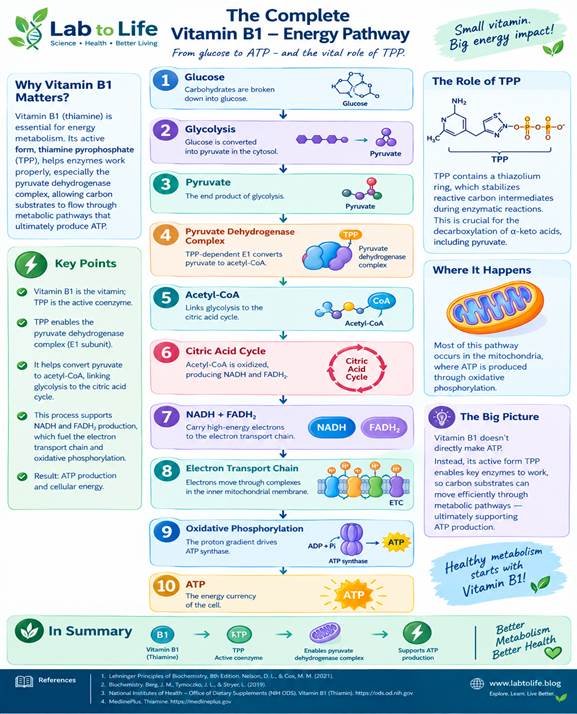
The entire concept can now be connected:
Glucose
↓
Glycolysis
↓
Pyruvate
↓
Pyruvate Dehydrogenase Complex
TPP-dependent E1
↓
Acetyl-CoA
↓
Citric Acid Cycle
↓
NADH + FADH₂
↓
Electron Transport Chain
↓
Oxidative Phosphorylation
↓
ATP
This is why thiamine is often discussed in the context of energy metabolism.
It does not directly “make ATP.” Instead, its active form TPP enables enzymes that allow carbon substrates to move efficiently through pathways that ultimately support ATP production.
10. Why Does TPP Work So Well in Decarboxylation Reactions?
This is the deeper biochemistry behind the pathway.
The thiazolium ring of TPP has a reactive carbon that can participate in stabilization of negatively charged intermediates.
In simple terms, TPP provides a chemical environment that makes the difficult carbon chemistry of α-ketoacid decarboxylation possible.
This is why TPP is used by several enzymes that process α-ketoacids.
Remember:
TPP is not simply “attached” to an enzyme.
It actively participates in the chemistry of the reaction.
That distinction is important when answering a university-level biochemistry question.
11. Other TPP-Dependent Pathways
Vitamin B1 is not only about pyruvate dehydrogenase.
A. α-Ketoglutarate Dehydrogenase
Inside the citric acid cycle:
α-Ketoglutarate
↓
α-Ketoglutarate dehydrogenase complex
↓
Succinyl-CoA
This enzyme complex also requires TPP.
Therefore, thiamine deficiency can affect the TCA cycle at another important point.
B. Branched-Chain α-Ketoacid Dehydrogenase
The branched-chain amino acids are:
- Leucine
- Isoleucine
- Valine
Their catabolism produces branched-chain α-ketoacids that are processed by the branched-chain α-ketoacid dehydrogenase complex (BCKDH).
TPP is required by this enzyme complex as well.
C. Transketolase
Transketolase operates in the pentose phosphate pathway.
This pathway is important for producing:
- NADPH
- Ribose-5-phosphate
NADPH supports reductive biosynthesis and antioxidant systems, while ribose-5-phosphate contributes to nucleotide synthesis.
Therefore, thiamine has roles extending beyond ATP production.
12. What Happens During Vitamin B1 Deficiency?
This is where the biochemical pathway becomes clinically significant.
When thiamine availability becomes insufficient, TPP-dependent enzymes may not function normally.
For pyruvate dehydrogenase:
↓ Vitamin B1
↓
↓ TPP availability
↓
↓ TPP-dependent E1 activity
↓
↓ Pyruvate → acetyl-CoA
↓
More pyruvate available for alternative pathways
↓
↑ Lactate formation
↓
Possible lactate accumulation
This is one biochemical explanation for why severe thiamine deficiency can be associated with elevated lactate.
When thiamine availability is inadequate, reduced TPP-dependent pyruvate dehydrogenase activity can impair pyruvate oxidation and contribute to increased lactate production.
Under normal aerobic conditions, pyruvate can enter mitochondrial oxidative metabolism through PDC.
When PDC activity is impaired, pyruvate can instead be converted into lactate by lactate dehydrogenase.
Normal direction
Glucose → Pyruvate → Acetyl-CoA → TCA cycle
When PDC activity is impaired
Glucose → Pyruvate → Lactate
This does not mean that every case of elevated lactate is caused by thiamine deficiency. Many conditions can increase lactate.
The biochemical point is that thiamine deficiency is one potential contributor when pyruvate oxidation is impaired.
14. Why Is the Brain Particularly Vulnerable?
The brain has a very high and continuous requirement for energy.
Because thiamine-dependent enzymes contribute to energy metabolism, severe thiamine deficiency can interfere with normal neuronal function.
This helps explain why severe deficiency can produce neurological manifestations.
Thiamine deficiency is associated with conditions including:
Beriberi
A disorder that can affect the nervous system and cardiovascular system.
Wernicke encephalopathy
An acute neurological disorder associated with severe thiamine deficiency.
Korsakoff syndrome
A chronic neuropsychiatric syndrome that can follow or coexist with Wernicke encephalopathy.
Thiamine deficiency can impair several metabolic pathways simultaneously, rather than affecting only pyruvate dehydrogenase.
15. Clinical Manifestations of Thiamine Deficiency
The clinical presentation depends on the severity and circumstances of deficiency.
Neurological manifestations may include:
- Confusion
- Memory impairment
- Peripheral neuropathy
- Muscle weakness
- Problems with coordination
Cardiovascular manifestations may include:
- Tachycardia
- Circulatory problems
- Heart failure in severe cases
Metabolic consequences may include:
- Impaired carbohydrate oxidation
- Reduced cellular energy production
- Increased lactate under some circumstances
Severe deficiency may lead to beriberi or Wernicke-Korsakoff syndrome.
16. Who Is at Risk of Vitamin B1 Deficiency?
Thiamine deficiency is more likely when intake is inadequate, absorption is impaired, requirements are increased or losses are increased.
Important risk situations include:
- Severe malnutrition
- Alcohol dependence
- Certain gastrointestinal disorders
- Bariatric surgery
- Conditions affecting nutrient absorption
- Prolonged inadequate nutritional intake
The NIH specifically identifies alcohol dependence and bariatric surgery among situations associated with increased risk.
17. Vitamin B1 and Metabolic Diseases
Thiamine should not be viewed as a treatment for every metabolic disease.
However, its biochemical importance means that thiamine-dependent pathways are relevant to many metabolic disorders.
The pyruvate dehydrogenase complex itself is a major metabolic control point because it determines whether pyruvate proceeds toward acetyl-CoA and mitochondrial oxidation.
Altered regulation of PDC has been studied in conditions including:
- Type 2 diabetes
- Obesity
- Cancer metabolism
- Neurological disorders
However, the relationship is complex, and altered PDC activity does not mean that thiamine supplementation is automatically an appropriate treatment.
18. Pyruvate Dehydrogenase Deficiency
Students should distinguish thiamine deficiency from pyruvate dehydrogenase deficiency.
They are not the same disorder.
Thiamine deficiency
The problem is inadequate availability of the vitamin/cofactor needed by TPP-dependent enzymes.
Pyruvate dehydrogenase deficiency
The problem is generally related to genetic or molecular defects affecting the pyruvate dehydrogenase complex itself.
Some PDC disorders can show biochemical responses to thiamine in selected circumstances, but this should not be interpreted as meaning that all PDC deficiency is caused by lack of vitamin B1.
This distinction is particularly important in clinical biochemistry.
19. Regulation of Pyruvate Dehydrogenase
The PDC is not permanently switched on.
Its activity is carefully regulated according to the cell’s energy requirements.
In mammals, the complex is regulated primarily through phosphorylation and dephosphorylation.
Pyruvate dehydrogenase kinase (PDK)
PDK phosphorylates PDC and decreases its activity.
Pyruvate dehydrogenase phosphatase (PDP)
PDP removes the phosphate group and activates PDC.
This allows the cell to adjust pyruvate oxidation according to its metabolic state.
20. The Complete Pathway at a Glance
Vitamin B1
↓
Thiamine
↓
TPP/TDP
↓
E1 of Pyruvate Dehydrogenase
↓
Pyruvate
↓
CO₂ removed
↓
Acetyl group transferred
↓
Acetyl-CoA
↓
Citric Acid Cycle
↓
NADH + FADH₂
↓
Electron Transport Chain
↓
ATP
21. What Happens When the Pathway Breaks?
Normal pathway
Vitamin B1 → TPP → PDC → Acetyl-CoA → TCA → ATP
Thiamine deficiency
↓ B1 → ↓ TPP → ↓ PDC activity → impaired pyruvate oxidation → ↑ lactate → impaired energy metabolism
Clinical consequence
Depending on severity and duration:
Metabolic dysfunction → neurological and/or cardiovascular manifestations
22. Food Sources of Vitamin B1
Thiamine can be obtained from a range of foods.
Common sources include:
- Whole grains
- Legumes
- Nuts
- Seeds
- Pork
- Fish
- Fortified cereals and grains
Dietary requirements vary by age, sex and physiological state. For adults, the NIH lists approximately 1.1 mg/day for women and 1.2 mg/day for men, with higher needs during pregnancy and breastfeeding.
A balanced diet generally provides thiamine for healthy individuals, while people with medical or nutritional risk factors may require professional assessment.
23. High-Yield Exam Table
| Concept | Remember |
| Vitamin B1 | Thiamine |
| Active coenzyme | TPP/TDP |
| Main PDC component using TPP | E1 |
| Starting substrate | Pyruvate |
| Carbon dioxide | Released |
| Final carbon product | Acetyl-CoA |
| Reduced electron carrier | NADH |
| Acetyl-CoA destination | Citric acid cycle |
| Major TPP-dependent pathway besides PDC | TCA cycle / PPP / BCAA metabolism |
| Severe deficiency | Beriberi, Wernicke-Korsakoff syndrome |
| Important metabolic consequence | Impaired oxidative metabolism; lactate may rise |
24. Frequently Asked Questions
What is the relationship between vitamin B1 and pyruvate dehydrogenase?
Vitamin B1 is converted into TPP, the active coenzyme form required by the E1 component of the pyruvate dehydrogenase complex. TPP participates in the decarboxylation of pyruvate.
What is the active form of vitamin B1?
The major metabolically active form is thiamine diphosphate (TDP), also known as thiamine pyrophosphate (TPP).
Which component of pyruvate dehydrogenase requires TPP?
The E1 component, pyruvate dehydrogenase, is TPP-dependent.
What does pyruvate dehydrogenase produce?
The overall reaction produces acetyl-CoA, CO₂ and NADH, along with H⁺.
Why does thiamine deficiency affect energy metabolism?
Thiamine deficiency can reduce the function of several TPP-dependent enzymes, including pyruvate dehydrogenase and α-ketoglutarate dehydrogenase. This can impair oxidative metabolism and ATP generation.
Can vitamin B1 deficiency cause high lactate?
Severe thiamine deficiency can impair pyruvate oxidation and contribute to increased lactate production. However, elevated lactate has many possible causes and is not specific for thiamine deficiency.
What diseases are associated with severe thiamine deficiency?
Severe thiamine deficiency can cause beriberi and neurological syndromes including Wernicke encephalopathy and Korsakoff syndrome.
25. One-Minute Revision
If you are preparing for an exam, remember this chain:
B1 → TPP → E1 → Pyruvate → Acetyl-CoA → TCA → ATP
And remember the deficiency chain:
↓ B1 → ↓ TPP → ↓ PDC → ↓ pyruvate oxidation → ↑ lactate → impaired energy metabolism
Finally:
TPP-dependent enzymes
PDH + α-KGDH + BCKDH + Transketolase
That small set of relationships explains a surprisingly large part of the biochemical importance of vitamin B1.
Key Takeaways
- Vitamin B1 is thiamine.
- Its major metabolically active form is TPP/TDP.
- TPP is required by the E1 component of pyruvate dehydrogenase.
- PDC converts pyruvate into acetyl-CoA.
- The reaction releases CO₂ and produces NADH.
- Acetyl-CoA enters the citric acid cycle.
- TPP is also required by α-ketoglutarate dehydrogenase, BCKDH and transketolase.
- Thiamine deficiency can impair central energy metabolism.
- Severe deficiency can cause beriberi and Wernicke-Korsakoff syndrome.
- Increased lactate can occur when pyruvate oxidation is impaired.
- Thiamine deficiency and genetic pyruvate dehydrogenase deficiency are different conditions.
References
- National Institutes of Health, Office of Dietary Supplements. Thiamin — Health Professional Fact Sheet. NIH ODS.
- Lonsdale D. Thiamin. Advances in Nutrition. 2017;8(2):329–333.
- Perham RN. The pyruvate dehydrogenase multienzyme complex. Biochemical Society Transactions. The review describes the organization and catalytic roles of E1, E2 and E3.
- Patel MS, Korotchkina LG. The interaction of E1 and E3 components with the core proteins of the human pyruvate dehydrogenase complex. Journal of Biological Chemistry.
- Manzetti S, Zhang J, van der Spoel D. Thiamine function, metabolism, uptake, and transport. Biochemistry.
- Whitfield KC, Bourassa MW, Adamolekun B, et al. Thiamine deficiency disorders: diagnosis, prevalence, and a roadmap for global control programs. Annals of the New York Academy of Sciences.
- Neurological, Psychiatric, and Biochemical Aspects of Thiamine Deficiency in Children and Adults. Peer-reviewed review available through PubMed Central.
- Huang, J., Huang, L. t., Wang, X., You, C., Feng, Y., Li, Y., Zeng, M., Zhu, C., Huang, Y., & Qin, L. (2026). Thiamine diphosphate-dependent enzymes: Mechanistic principles, stereoselective CC bond formation, and synthetic biocatalytic applications. Organic & Biomolecular Chemistry.
- Mrowicka, M., Mrowicki, J., Dragan, G., & Majsterek, I. (2023). The importance of thiamine (vitamin B1) in humans. Bioscience Reports, 43(10), BSR20230374.
- Schostak, T., San Millan, I., Jani, A., & Johnson, R. J. (2023). Thiamine deficiency: a commonly unrecognised but easily treatable condition. Postgraduate medical journal, 99(1174), 844-848.