
Carbohydrates, commonly called carbs, are one of the three major macronutrients in the diet, alongside protein and fat. They are found in foods such as grains, fruits, vegetables, beans, milk, and many processed foods.
During digestion, many digestible carbohydrates are broken down into glucose, which the body can use as an important source of energy (Vieira et al., 2025). Glucose can be used immediately by cells or stored for later use, including in the liver and muscles.
But carbohydrates are not all nutritionally identical. A bowl of oats, a piece of fruit, a serving of lentils, and a sugary soft drink all contain carbohydrates, yet they provide very different combinations of fiber, vitamins, minerals, and other nutrients.
That is why understanding carbohydrate type and food quality is more useful than simply asking whether a food is “high-carb” or “low-carb.”(Chauncey, 2022).
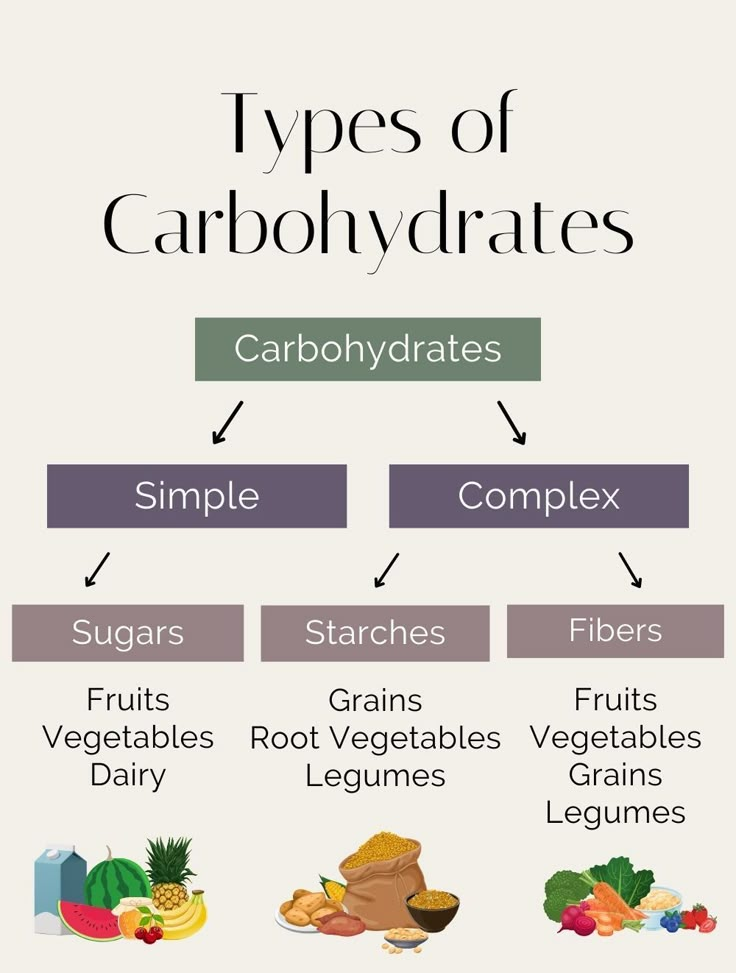
Types, Functions & Food Sources
A Science-Based Guide to Carbs
What Are the 3 Main Types of Carbohydrates?
The three main types of carbohydrates found in foods are:
- Sugars
- Starches
- Fiber
Sugars and starches can be digested and contribute glucose for energy, while most dietary fiber is not broken down and absorbed in the same way.
| Type | What it is | Common food sources |
| Sugars | Simple carbohydrates consisting of one or two sugar units | Fruit, milk, honey, sweets, soft drinks |
| Starches | Complex carbohydrates made from many linked sugar units | Potatoes, rice, oats, bread, pasta, beans |
| Fiber | Carbohydrate that the body cannot fully digest | Whole grains, vegetables, fruits, legumes, nuts and seeds |
1. Sugars
Sugars are the simplest forms of carbohydrate. They can occur naturally in foods or be added during food processing.
Natural sources include:
- Fruits
- Milk
- Yogurt
- Some vegetables
Added sugars are common in:
- Sweets
- Cakes
- Biscuits/cookies
- Desserts
- Sugar-sweetened beverages
- Syrups
An important distinction is that total sugar is not the same as added sugar. For example, the sugar naturally present in fruit or milk is included in total sugars, whereas added sugars are those incorporated during processing or preparation (Cywińska-Antonik et al., 2023).
2. Starches
Starch is a complex carbohydrate made up of many linked sugar units.
Common sources include:
- Potatoes
- Rice
- Bread
- Pasta
- Oats
- Corn
- Peas
- Beans
- Lentils
- Other grains
Starchy foods can be an important part of a balanced diet. The NHS recommends choosing higher-fiber or wholegrain versions where possible, such as wholewheat pasta, brown rice and higher-fiber bread (Lin & Gómez-Maqueo, 2023).
However, not every starchy food has the same nutritional profile. Refined grains can have less fiber and fewer naturally occurring nutrients than intact or minimally processed whole grains.
3. Fiber
Fiber is a type of carbohydrate that the human digestive system cannot completely break down.
Good sources include:
- Beans and lentils
- Whole grains
- Oats
- Fruits
- Vegetables
- Nuts
- Seeds
Fiber can support digestive health and help with feelings of fullness. Different types of fiber have different effects; for example, soluble fiber can interact with glucose and cholesterol metabolism, while insoluble fiber contributes to normal bowel function.
Why is fiber important?
A useful way to think about carbohydrate quality is:
Carbohydrate + fiber + nutrients + degree of processing = overall food quality
This is one reason whole grains, vegetables, fruits and legumes are commonly emphasized in healthy eating patterns (Arts, 2025).
What Do Carbohydrates Do in the Body?
Carbohydrates perform several important functions.
1. Provide energy
Digestible carbohydrates can be converted into glucose, which cells use as an energy source. Glucose is particularly important for tissues that rely heavily on glucose availability, including the brain.
2. Support physical activity
Carbohydrate-derived glucose can be used during physical activity. Some glucose can also be stored as glycogen in the muscles and liver for later use (Kane et al., 2025).
3. Provide dietary fiber
Carbohydrate-containing plant foods can provide fiber, which supports normal digestive function and contributes to fullness.
4. Supply vitamins, minerals and plant compounds
Carbohydrate-rich foods such as whole grains, fruits, vegetables and legumes can provide nutrients beyond carbohydrate itself, including vitamins, minerals and various plant compounds.
How Are Carbohydrates Digested?
Digestion begins in the mouth and continues through the digestive tract.
Digestible carbohydrates are broken down into smaller molecules, ultimately producing simple sugars that can be absorbed. Glucose then enters the bloodstream and can be taken up by cells for energy or stored for later use.
After carbohydrate-containing foods are eaten, blood glucose rises. The pancreas responds by releasing insulin, which helps cells take up glucose. The body also uses other hormonal mechanisms, including glucagon, to help regulate blood glucose between meals (Hilpisch).
Fiber is different. Most fiber is not broken down into glucose in the same way as digestible carbohydrate.
Simple vs Complex Carbohydrates
You may have heard carbohydrates divided into simple carbs and complex carbs.
Traditionally:
- Simple carbohydrates = sugars with one or two sugar units
- Complex carbohydrates = starches and other carbohydrates made from longer chains
However, this classification has limitations.
For example, fruit contains naturally occurring simple sugars but also provides fiber, vitamins, minerals and other beneficial compounds. On the other hand, some refined foods contain complex starches but may be relatively low in fiber.
So, rather than judging a carbohydrate solely by whether it is “simple” or “complex,” it is useful to consider:
- Fiber content
- Degree of processing
- Added sugar
- Portion size
- Overall nutrient content
- The food’s effect on blood glucose
Related reading: Simple vs Complex Carbohydrates: What’s the Difference?
What Foods Contain Carbohydrates?
Carbohydrates occur in a wide range of foods.
Whole grains
Examples include:
- Oats
- Brown rice
- Whole-wheat bread
- Barley
- Quinoa
- Wholegrain cereals
- Wholewheat pasta
Whole grains retain the bran, germ and endosperm, providing fiber and other nutrients that can be reduced during refining.
Fruits
Examples include:
- Apples
- Bananas
- Berries
- Oranges
- Pears
- Mangoes
- Grapes
Fruit provides naturally occurring sugars along with fiber and micronutrients.
Vegetables
Carbohydrate-containing vegetables include:
- Potatoes
- Sweet potatoes
- Corn
- Peas
- Carrots
- Beetroot
- Squash
Legumes
Legumes are particularly useful carbohydrate sources because they can provide both carbohydrate and substantial amounts of fiber and plant protein.
Examples include:
- Lentils
- Chickpeas
- Kidney beans
- Black beans
- Peas
Dairy foods
Milk and yogurt naturally contain the carbohydrate lactose.
Processed foods
Carbohydrates are also found in:
- Cakes
- Biscuits/cookies
- Pastries
- Sweets/candy
- Breakfast cereals
- Soft drinks
- Sweetened beverages
- Snack foods
The presence of carbohydrate alone does not determine whether a food is nutritious. The overall nutritional composition matters.
Healthy Carbohydrate Sources
Examples of nutrient-rich carbohydrate foods
| Food | Main carbohydrate contribution | Other nutritional features |
| Oats | Starch + fiber | Fiber, minerals |
| Lentils | Starch + fiber | Plant protein, minerals |
| Beans | Starch + fiber | Protein, fiber |
| Brown rice | Starch + fiber | Whole-grain nutrients |
| Berries | Natural sugars + fiber | Vitamins and plant compounds |
| Potatoes with skin | Starch + fiber | Potassium and other nutrients |
| Whole-wheat bread | Starch + fiber | B vitamins and minerals |
| Quinoa | Starch + fiber | Protein and minerals |
Refined vs Whole-Grain Carbohydrates
One of the most important distinctions is whole grain versus refined grain.
A whole grain contains three main components:
Bran → Germ → Endosperm
During refining, the bran and germ can be removed, leaving primarily the endosperm. This can reduce the amount of fiber and some nutrients in the final food.
Examples
Whole-grain options:
- Oatmeal
- Brown rice
- Whole-wheat bread
- Barley
- Wholewheat pasta
Refined options:
- White bread
- White rice
- Refined pasta
- Many refined-flour baked products
This does not mean refined grains must never be eaten. Rather, wholegrain and higher-fiber choices can provide more fiber and nutrients.
Carbohydrates and Blood Sugar
Carbohydrate-containing foods can affect blood glucose differently.
The glycemic index (GI) is one method used to classify carbohydrate-containing foods according to how quickly they raise blood glucose compared with a reference food.
However, GI does not tell the whole story. Processing, fiber, food structure, ripeness, meal composition and portion size can all influence the body’s glucose response.
For this reason, the idea that “all carbs are bad for blood sugar” is an oversimplification.
Whole oats, beans, fruit and refined sugary foods are all carbohydrate-containing foods, but their nutritional composition and physiological effects can differ substantially.
How Many Carbohydrates Do You Need?
There is no single carbohydrate intake that is appropriate for everyone.
Individual needs can vary according to factors such as:
- Age
- Sex
- Energy requirements
- Physical activity
- Health conditions
- Dietary pattern
- Individual goals
MedlinePlus notes that, on average, carbohydrates account for approximately 45–65% of daily calories in its general nutrition guidance, while the FDA’s Nutrition Facts label uses 275 g/day as the Daily Value for total carbohydrate based on a 2,000-calorie diet. These are reference values, not personalized prescriptions.
People managing diabetes or other medical conditions may need individualized carbohydrate guidance from a qualified healthcare professional.
Are Carbohydrates Bad for You?
No. Carbohydrates are not inherently unhealthy.
The important question is which carbohydrate-containing foods make up the diet.
Foods such as whole grains, vegetables, fruits and legumes can provide carbohydrate together with fiber and other nutrients. Highly processed foods can also contain carbohydrates, but may provide substantial added sugars, refined starches or calories with fewer nutrients.
The key distinction is therefore food quality and dietary pattern, rather than simply labeling carbohydrates as “good” or “bad.”
How to Choose Better Carbohydrate Foods
When shopping or planning meals, try these practical strategies:
Choose more often
- Whole grains
- Oats
- Beans and lentils
- Whole fruits
- Vegetables
- Higher-fiber breads and cereals
- Potatoes with their skins when appropriate
Check food labels
For packaged foods, look at:
- Total carbohydrate
- Fiber
- Added sugars
- Serving size
- Ingredient list
The FDA explains that the Nutrition Facts label separates total sugars from added sugars, making it easier to identify how much sugar has been added to a packaged food or drink.
The Bottom Line
Carbohydrates are an important source of energy and occur naturally in a wide variety of foods.
The three major types are sugars, starches and fiber. Carbohydrate-containing foods include fruits, vegetables, grains, potatoes, beans, lentils and dairy products, as well as sweets and sugar-sweetened beverages (Arts, 2025).
For overall diet quality, it is more useful to focus on fiber-rich, minimally processed carbohydrate foods and the nutritional quality of the entire food rather than simply avoiding carbohydrates.
Think beyond “carbs”: look at the whole food.
References
Arts, C. (2025). Carbohydrate basics: sugars, starches and fibers in foods and health. Culinary nutrition: the science and practice of healthy cooking, 173.
Chauncey, K. B. (2022). Low-Carb Diet For Dummies. John Wiley & Sons.
Cywińska-Antonik, M., Chen, Z., Groele, B., & Marszałek, K. (2023). Application of emerging techniques in reduction of the sugar content of fruit juice: current challenges and future perspectives. Foods, 12(6), 1181.
Hilpisch, Y. J. Blood Sugar & Insulin.
Kane, D. A., Goodwin, M. L., & Gladden, L. B. (2025). Lactate metabolism in health and disease. The Skeletal Muscle: Plasticity, Degeneration and Epigenetics, 573-613.
Lin, A. H.-M., & Gómez-Maqueo, A. (2023). Strengthening food security through alternative carbohydrates in the city-state of Singapore. Frontiers in Sustainable Food Systems, 7, 987402.
Vieira, B. M., Silva, G. N. d. M. e., & Silva, M. I. (2025). Nutritional elements I: nutrients, proteins, carbohydrates, and lipids. In Fundamentals of drug and non-drug interactions: Physiopathological perspectives and clinical approaches (pp. 35-56). Springer.