
Introduction: What Happens After Glycolysis?
When you eat carbohydrate-rich foods, digestion breaks many carbohydrates down into glucose. Your cells can use this glucose to produce energy through a series of biochemical reactions known as carbohydrate metabolism.
The first major pathway in glucose breakdown is glycolysis. During glycolysis, one glucose molecule is converted into two pyruvate molecules, producing a net gain of two ATP molecules and two NADH molecules.
But glycolysis is not the end of glucose metabolism. Pyruvate still contains energy that the cell can extract through subsequent pathways.
The next important step, under aerobic metabolic conditions, is pyruvate oxidation. During this process, pyruvate is converted into acetyl-CoA, a molecule that can enter the Krebs cycle, also known as the citric acid cycle.
In this article, we will explain pyruvate oxidation in simple language, explore its location and enzymes, follow the reaction step by step, and understand how it contributes to cellular energy production.
What Is Pyruvate Oxidation?
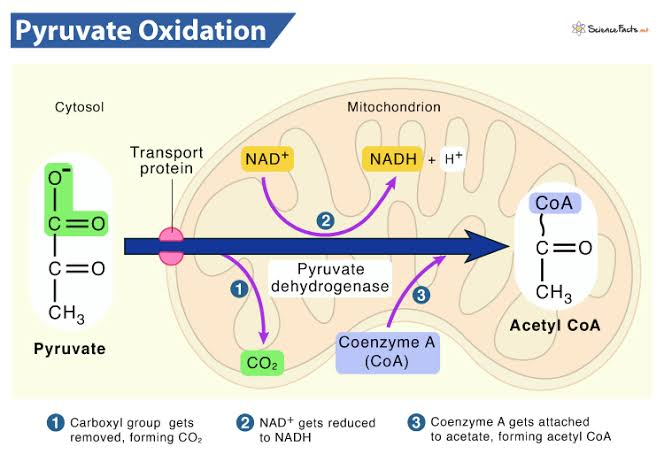
Pyruvate oxidation is a biochemical process that converts pyruvate into acetyl-CoA while producing carbon dioxide and NADH.
It connects glycolysis with the citric acid cycle, which is why it is also called the link reaction or bridge reaction.
Pyruvate contains three carbon atoms. During its conversion into acetyl-CoA, one carbon is released as carbon dioxide, leaving a two-carbon acetyl group that attaches to coenzyme A.
The simplified reaction is:
Pyruvate + CoA-SH + NAD⁺ → Acetyl-CoA + CO₂ + NADH + H⁺
This reaction is catalysed by a group of enzymes called the pyruvate dehydrogenase complex (PDC).
For every molecule of pyruvate, the reaction produces one acetyl-CoA, one carbon dioxide molecule, and one NADH molecule.
Since glycolysis produces two pyruvate molecules from one glucose molecule, pyruvate oxidation occurs twice per glucose.

Where Does Pyruvate Oxidation Occur?
In human cells, pyruvate oxidation takes place in the mitochondrial matrix, the innermost compartment of the mitochondrion.
Glycolysis occurs in the cytosol, whereas pyruvate oxidation and most reactions of the citric acid cycle occur in the mitochondrial matrix.
Before pyruvate oxidation begins, pyruvate must be transported from the cytosol into the mitochondrial matrix.
This separation allows different stages of cellular respiration to occur in specific cellular compartments.
Remember:
- Glycolysis: cytosol
- Pyruvate oxidation: mitochondrial matrix
- Citric acid cycle: mainly mitochondrial matrix
- Electron transport chain: inner mitochondrial membrane
In prokaryotic cells, which lack mitochondria, pyruvate oxidation occurs in the cytoplasm.
Pyruvate Oxidation Pathway: A Simple Flowchart
Follow the pathway from the end of glycolysis to the beginning of the Krebs cycle.
              GLUCOSE
                 |
                 v
             GLYCOLYSIS
        Location: Cytosol
                 |
                 v
          2 PYRUVATE
        3 carbons each
                 |
                 v
      Entry into mitochondria
                 |
                 v
        PYRUVATE OXIDATION
     Enzyme: Pyruvate dehydrogenase
                 |
        +--------+--------+
        |        |        |
        v        v        v
   ACETYL-CoA    CO2     NADH
   2 carbons   Released  Energy
        |
        v
   KREBS CYCLE
        |
        v
  NADH + FADH2 + ATP/GTP
        |
        v
 OXIDATIVE PHOSPHORYLATION
        |
        v
    MORE ATP
This flowchart shows how pyruvate oxidation connects the breakdown of glucose to the pathways responsible for producing most of the ATP during aerobic glucose oxidation.
The Three Main Steps of Pyruvate Oxidation
Pyruvate oxidation is carried out by the pyruvate dehydrogenase complex. Its overall reaction can be understood as three closely coordinated steps.
Step 1: Removal of Carbon Dioxide
The first step involves removing a carboxyl group from pyruvate.
Pyruvate contains three carbon atoms. One carbon is released as carbon dioxide (CO₂), leaving a two-carbon fragment.
This process is called decarboxylation.
The release of carbon dioxide is an important part of cellular respiration. During the complete oxidation of glucose, its carbon atoms are eventually released as carbon dioxide.
Step 2: Oxidation and NADH Formation
The remaining two-carbon fragment is oxidised.
During this process, electrons are transferred through the enzyme complex, and NAD⁺ accepts electrons to become NADH.
NADH is an electron carrier. It transports high-energy electrons that can later contribute to ATP production through the mitochondrial electron transport chain.
This step connects the chemical breakdown of pyruvate with the cell’s energy-generating systems.
Step 3: Formation of Acetyl-CoA
The two-carbon acetyl group attaches to coenzyme A (CoA), producing acetyl-CoA.
Coenzyme A acts as a carrier that helps deliver the acetyl group to the citric acid cycle.
Acetyl-CoA is therefore the key product that allows carbon derived from glucose to enter the next stage of aerobic metabolism.
The Pyruvate Dehydrogenase Complex: Which Enzymes Are Involved?
The pyruvate dehydrogenase complex is a large enzyme assembly that coordinates the conversion of pyruvate into acetyl-CoA.
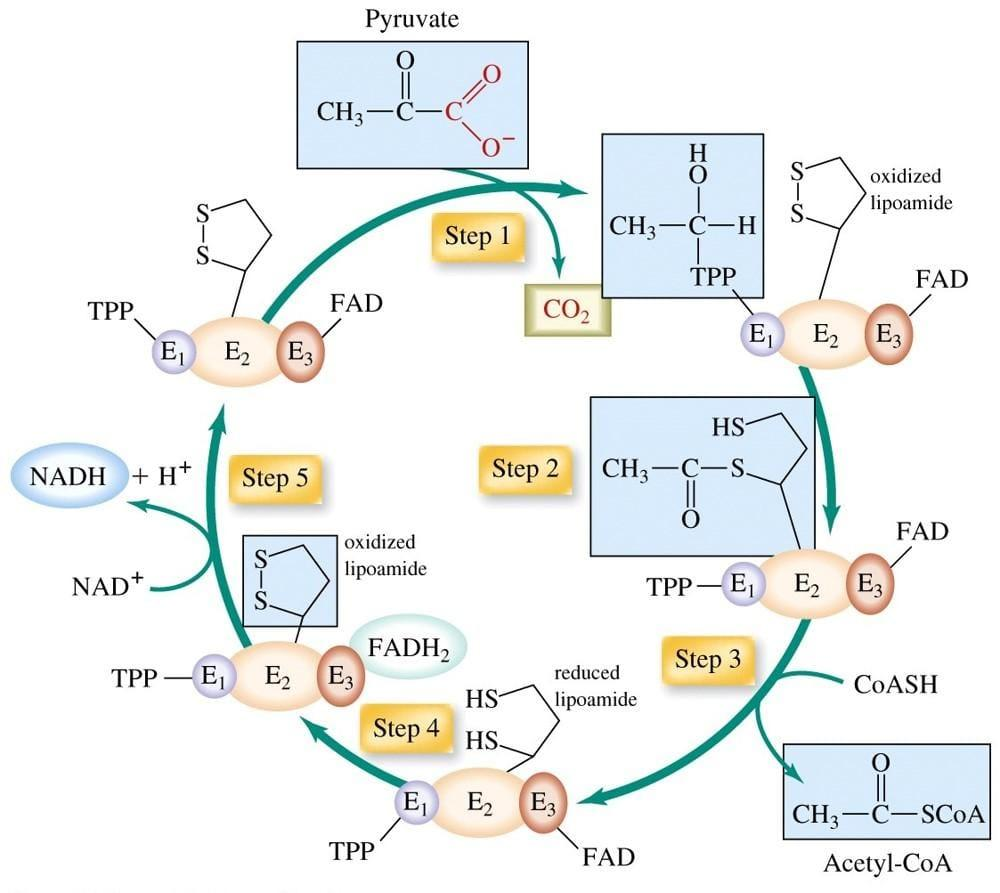
It contains three major enzyme components:
| Enzyme component | Main function |
|---|---|
| E1: Pyruvate dehydrogenase | Removes carbon dioxide from pyruvate |
| E2: Dihydrolipoyl transacetylase | Transfers the acetyl group to coenzyme A |
| E3: Dihydrolipoyl dehydrogenase | Helps regenerate the oxidised form of the complex and supports electron transfer |
The complex uses several cofactors, including thiamine pyrophosphate (TPP), lipoamide, coenzyme A, FAD and NAD⁺.
These molecules assist the enzyme complex in carrying out the reaction efficiently.
Some of these cofactors are derived from vitamins. For example, TPP is derived from vitamin B1, while FAD is derived from vitamin B2 and coenzyme A contains a component derived from vitamin B5.
This is one reason why vitamins are essential for normal energy metabolism: they help support biochemical reactions that process nutrients.
Energy Yield of Pyruvate Oxidation
Pyruvate oxidation does not directly produce ATP. Instead, it produces NADH, which can contribute to ATP production later.
The energy yield per pyruvate molecule is:
- One NADH
- One acetyl-CoA
- One carbon dioxide molecule
- No direct ATP production
Because one glucose molecule produces two pyruvate molecules during glycolysis, the total yield per glucose is:
| Product | Per pyruvate | Per glucose |
|---|---|---|
| Acetyl-CoA | 1 | 2 |
| NADH | 1 | 2 |
| Carbon dioxide | 1 | 2 |
| Direct ATP | 0 | 0 |
The two NADH molecules generated during pyruvate oxidation are additional to the two NADH molecules formed during glycolysis.
Important: NADH is not ATP. It carries electrons that can support ATP generation during oxidative phosphorylation. The actual amount of ATP generated depends on cellular conditions and the processes through which electrons are transferred.
What Happens to Acetyl-CoA Next?
After pyruvate oxidation, acetyl-CoA enters the citric acid cycle when the appropriate metabolic conditions are present.
The cycle begins when the two-carbon acetyl group combines with oxaloacetate, a four-carbon molecule, to form citrate, a six-carbon molecule.
Through a series of enzyme-controlled reactions, citrate is processed and oxaloacetate is regenerated. This makes the pathway a cycle rather than a straight sequence.
For each acetyl-CoA molecule, one turn of the cycle produces approximately:
- Three NADH molecules
- One FADH₂ molecule
- One GTP or ATP molecule
- Two carbon dioxide molecules
Because one glucose molecule produces two acetyl-CoA molecules, the cycle turns twice per glucose.
NADH and FADH₂ carry electrons to the electron transport chain, where their energy supports ATP production through oxidative phosphorylation.
Pyruvate Oxidation vs. Glycolysis vs. the Krebs Cycle
These three stages are connected but perform different functions.
| Feature | Glycolysis | Pyruvate oxidation | Krebs cycle |
|---|---|---|---|
| Main location in human cells | Cytosol | Mitochondrial matrix | Mitochondrial matrix |
| Main starting molecule | Glucose | Pyruvate | Acetyl-CoA |
| Main product | Pyruvate | Acetyl-CoA | Carbon dioxide and electron carriers |
| Direct ATP production | Net 2 ATP per glucose | None | 1 GTP/ATP per acetyl-CoA |
| NADH production | 2 per glucose | 2 per glucose | 6 per glucose |
| Main role | Splits glucose | Links glycolysis to the cycle | Extracts more energy from acetyl groups |
The NADH values in the table are for one glucose molecule, assuming the two pyruvate molecules and two acetyl-CoA molecules are fully processed through the relevant pathways.
Why Is Pyruvate Oxidation Important?
Pyruvate oxidation is important because it connects the initial breakdown of glucose to the metabolic pathways that extract more energy from it.
1. It connects glycolysis with the Krebs cycle. Without the conversion of pyruvate into acetyl-CoA, glucose-derived carbon would not enter the citric acid cycle through this route.
2. It produces NADH. NADH carries electrons that can support ATP production through oxidative phosphorylation.
3. It releases carbon dioxide. The reaction is one of the stages in which carbon from glucose is released as CO₂.
4. It helps regulate glucose oxidation. The pyruvate dehydrogenase complex is regulated according to the cell’s energy requirements and metabolic state.
5. It links nutrient metabolism. Acetyl-CoA is an important metabolic intermediate involved in carbohydrate, fat and some amino acid metabolism.
Frequently Asked Questions About Pyruvate Oxidation
Is pyruvate oxidation the same as glycolysis?
No. Glycolysis converts glucose into pyruvate in the cytosol. Pyruvate oxidation then converts pyruvate into acetyl-CoA, mainly in the mitochondrial matrix of human cells.
Does pyruvate oxidation produce ATP?
No ATP is produced directly during pyruvate oxidation. The process produces NADH, which can support ATP production later through oxidative phosphorylation.
Why is pyruvate oxidation called the link reaction?
It is called the link reaction because it connects glycolysis with the citric acid cycle by converting pyruvate into acetyl-CoA.
Does pyruvate oxidation require oxygen?
The reaction itself does not directly consume oxygen. However, its sustained operation in aerobic metabolism depends on the cell’s ability to regenerate NAD⁺ and maintain mitochondrial metabolic activity. When pyruvate is instead converted into lactate, NAD⁺ can be regenerated without directly using oxygen in that reaction.
How many NADH molecules are produced from one glucose during pyruvate oxidation?
Two NADH molecules are produced because one glucose molecule produces two pyruvate molecules during glycolysis.
What is the role of acetyl-CoA?
Acetyl-CoA carries a two-carbon acetyl group into the citric acid cycle, where further reactions generate electron carriers and a small amount of ATP or GTP.
Conclusion
Pyruvate oxidation is an essential stage of carbohydrate metabolism because it converts pyruvate from glycolysis into acetyl-CoA, allowing glucose-derived carbon to enter the citric acid cycle.
The key facts to remember are:
- It occurs in the mitochondrial matrix in human cells.
- The pyruvate dehydrogenase complex catalyses the reaction.
- Each pyruvate produces one acetyl-CoA, one NADH and one carbon dioxide molecule.
- One glucose produces two pyruvate molecules, so the reaction occurs twice per glucose.
- No ATP is produced directly during this stage.
- Acetyl-CoA enters the citric acid cycle for further energy extraction.
Understanding pyruvate oxidation makes it easier to learn the next stage of cellular respiration: the Krebs cycle.
At Lab to Life, we aim to explain complex biological processes in clear, accessible language so readers can connect biochemistry with the science of everyday life.
References and Further Reading
- OpenStax. Biology 2e: 7.3 Oxidation of Pyruvate and the Citric Acid Cycle. https://openstax.org/books/biology-2e/pages/7-3-oxidation-of-pyruvate-and-the-citric-acid-cycle
- Ferrier, D. R. Lippincott Illustrated Reviews: Biochemistry. Wolters Kluwer. Consult the edition available to you for detailed coverage of carbohydrate metabolism and the pyruvate dehydrogenase complex.
- Nelson, D. L., & Cox, M. M. Lehninger Principles of Biochemistry. W. H. Freeman. Consult the relevant chapter on glycolysis, pyruvate oxidation and the citric acid cycle.