

Introduction
Every day, we eat foods containing carbohydrates, including bread, rice, potatoes, fruits and cereals. During digestion, many of these carbohydrates are broken down into simple sugars, including glucose. Glucose can then enter the bloodstream and travel to cells, where it is used to produce energy.
But how does a cell convert glucose into usable energy?
The answer lies in carbohydrate metabolism, a collection of biochemical reactions that allows the body to break down, use and store carbohydrates. One of its most important pathways is glycolysis, the process through which a glucose molecule is converted into two molecules of pyruvate.
Glycolysis is especially important because it provides a rapid source of cellular energy and can operate without directly requiring oxygen.
In this article, we will explore carbohydrate metabolism, explain all ten steps of glycolysis in simple language, identify where each reaction occurs, and understand how ATP and NADH help cells capture energy.
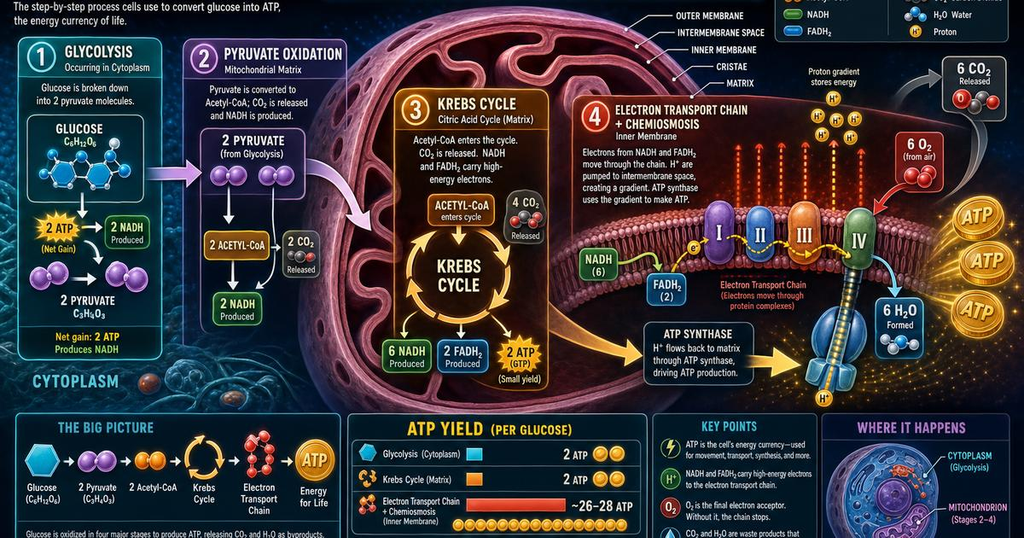
What Is Carbohydrate Metabolism?
Carbohydrate metabolism refers to the biochemical processes through which the body digests, absorbs, breaks down, stores and produces carbohydrates.
Glucose is a major fuel for many cells. Once glucose enters a cell, it may be used immediately for energy, stored as glycogen, or converted into other substances needed by the body.
The major pathways involved in carbohydrate metabolism include:
- Glycolysis: Breaks glucose into pyruvate and produces ATP and NADH.
- Glycogenesis: Converts glucose into glycogen for storage, mainly in the liver and skeletal muscles.
- Glycogenolysis: Breaks down glycogen to release glucose-related fuel for the body.
- Gluconeogenesis: Produces glucose from certain non-carbohydrate substances, such as lactate, glycerol and some amino acids.
- Citric acid cycle: Processes acetyl-CoA and generates electron carriers used in ATP production.
- Oxidative phosphorylation: Uses energy from electron transfer to generate most of the ATP produced during aerobic glucose oxidation.
These pathways work together to maintain energy availability and help regulate blood glucose levels.
What Is Glycolysis?
Glycolysis is a sequence of ten enzyme-controlled reactions that converts one molecule of glucose into two molecules of pyruvate.
The word glycolysis refers to the breakdown of sugar. During the pathway, the original six-carbon glucose molecule is divided into two three-carbon molecules.
The overall simplified reaction is:
Glucose → 2 Pyruvate + 2 ATP (net) + 2 NADH
Other products, including water and protons, are omitted from this simplified equation.
Glycolysis has two main phases:
- Energy investment phase: The cell uses two ATP molecules to prepare glucose for breakdown.
- Energy payoff phase: The pathway generates four ATP molecules and two NADH molecules.
After subtracting the two ATP molecules used at the beginning, the net yield is two ATP molecules per glucose.
Where Does Glycolysis Occur?
Glycolysis takes place in the cytosol, the fluid portion of the cell’s cytoplasm.
It does not occur inside mitochondria and does not directly require oxygen. It occurs in both prokaryotic and eukaryotic cells.
In human cells, mitochondria are involved in later stages of aerobic glucose metabolism. However, mature red blood cells lack mitochondria and depend on glycolysis to produce ATP.
Understanding the location of glycolysis helps distinguish it from the citric acid cycle and oxidative phosphorylation, which occur in mitochondria in human cells.
Glycolysis Pathway: A Simple Flowchart
The following flowchart summarizes how glucose moves through glycolysis.
              GLUCOSE
           6 carbon atoms
                  |
                  v
     ENERGY INVESTMENT PHASE
             2 ATP used
                  |
                  v
      FRUCTOSE-1,6-BISPHOSPHATE
                  |
                  v
        SPLITTING OF THE SUGAR
                  |
                  v
        2 THREE-CARBON MOLECULES
                  |
                  v
          2 MOLECULES OF G3P
                  |
                  v
       ENERGY PAYOFF PHASE
       2 NADH and 4 ATP formed
                  |
                  v
             2 PYRUVATE
        3 carbon atoms each

NET RESULT PER GLUCOSE:
2 ATP + 2 NADH + 2 PYRUVATE
G3P stands for glyceraldehyde-3-phosphate, a three-carbon intermediate that continues through the second half of glycolysis.
Important: After glucose is split, each subsequent reaction in the payoff phase occurs twice per original glucose molecule.
The Ten Steps of Glycolysis Explained
Glycolysis consists of ten reactions, each catalysed by a specific enzyme. For easier understanding, these reactions are divided into the energy investment and energy payoff phases.
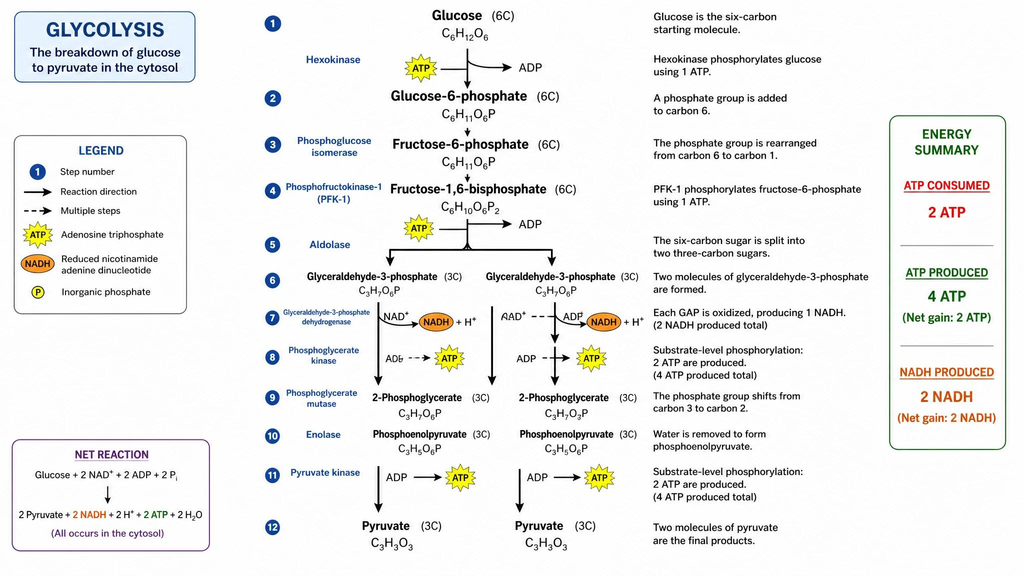
Phase 1: Energy Investment
During the first five steps, the cell uses two ATP molecules to prepare glucose for breakdown.
Step 1: Glucose to Glucose-6-Phosphate
Enzyme: Hexokinase or glucokinase in the liver and pancreatic beta cells.
Glucose enters the cell and receives a phosphate group from ATP. This reaction produces glucose-6-phosphate and ADP.
Adding the phosphate group helps retain glucose inside the cell and prepares it for further reactions.
Energy change: One ATP molecule is used.
Where it happens: Cytosol.
Step 2: Glucose-6-Phosphate to Fructose-6-Phosphate
Enzyme: Phosphoglucose isomerase.
The six-carbon sugar is rearranged from glucose-6-phosphate into fructose-6-phosphate.
Although the atoms remain the same, their arrangement changes. This makes the molecule suitable for the next reaction.
Energy change: No ATP is consumed or produced.
Where it happens: Cytosol.
Step 3: Fructose-6-Phosphate to Fructose-1,6-Bisphosphate
Enzyme: Phosphofructokinase-1 (PFK-1).
A second ATP molecule donates a phosphate group to fructose-6-phosphate, forming fructose-1,6-bisphosphate.
This is one of the most important regulatory steps of glycolysis. PFK-1 responds to signals about the cell’s energy status and helps control the pathway’s activity.
Energy change: One ATP molecule is used.
Where it happens: Cytosol.
Step 4: Splitting Fructose-1,6-Bisphosphate
Enzyme: Aldolase.
The six-carbon molecule is split into two three-carbon molecules:
- Glyceraldehyde-3-phosphate (G3P)
- Dihydroxyacetone phosphate (DHAP)
At this point, the original glucose molecule has been divided into two smaller molecules.
Energy change: No ATP is consumed or produced.
Where it happens: Cytosol.
Step 5: DHAP to G3P
Enzyme: Triose phosphate isomerase.
DHAP is converted into G3P. As a result, both three-carbon molecules can continue through the same energy-producing reactions.
One glucose molecule therefore generates two G3P molecules.
Energy change: No ATP is consumed or produced.
Where it happens: Cytosol.
End of the investment phase: Two ATP molecules have been used, and two G3P molecules are ready to enter the energy payoff phase.
Phase 2: Energy Payoff
The next five steps generate ATP and NADH. Since two G3P molecules are present, these reactions occur twice per original glucose molecule.
Step 6: G3P to 1,3-Bisphosphoglycerate
Enzyme: Glyceraldehyde-3-phosphate dehydrogenase.
Each G3P molecule is oxidised. NAD+ accepts electrons and is reduced to NADH. An inorganic phosphate is also added to the intermediate.
This reaction captures some of the energy released during the oxidation of G3P.
Energy change: Two NADH molecules are produced per glucose.
Where it happens: Cytosol.
Step 7: 1,3-Bisphosphoglycerate to 3-Phosphoglycerate
Enzyme: Phosphoglycerate kinase.
A phosphate group is transferred from 1,3-bisphosphoglycerate to ADP, producing ATP.
Because two three-carbon molecules pass through this reaction, two ATP molecules are produced.
This process is called substrate-level phosphorylation, in which a phosphate group is transferred directly from a metabolic intermediate to ADP.
Energy change: Two ATP molecules are produced per glucose.
Where it happens: Cytosol.
Step 8: 3-Phosphoglycerate to 2-Phosphoglycerate
Enzyme: Phosphoglycerate mutase.
The phosphate group changes position within the molecule, converting 3-phosphoglycerate into 2-phosphoglycerate.
This rearrangement prepares the molecule for the next reaction.
Energy change: No ATP is consumed or produced.
Where it happens: Cytosol.
Step 9: 2-Phosphoglycerate to Phosphoenolpyruvate
Enzyme: Enolase.
Water is removed from 2-phosphoglycerate, forming phosphoenolpyruvate (PEP).
PEP has a high potential for phosphate transfer, making it suitable for the next ATP-producing reaction.
Energy change: No ATP is consumed or produced.
Where it happens: Cytosol.
Step 10: Phosphoenolpyruvate to Pyruvate
Enzyme: Pyruvate kinase.
PEP transfers its phosphate group to ADP, producing ATP and pyruvate.
Since the reaction occurs twice per glucose molecule, two ATP molecules are generated.
Pyruvate is the final carbon-containing product of glycolysis.
Energy change: Two ATP molecules are produced per glucose.
Where it happens: Cytosol.
Summary of the Ten Steps
| Step | Main conversion | Enzyme | Energy change per glucose |
|---|---|---|---|
| 1 | Glucose → Glucose-6-phosphate | Hexokinase/glucokinase | −1 ATP |
| 2 | Glucose-6-phosphate → Fructose-6-phosphate | Phosphoglucose isomerase | None |
| 3 | Fructose-6-phosphate → Fructose-1,6-bisphosphate | PFK-1 | −1 ATP |
| 4 | Six-carbon sugar → G3P + DHAP | Aldolase | None |
| 5 | DHAP → G3P | Triose phosphate isomerase | None |
| 6 | G3P → 1,3-bisphosphoglycerate | G3P dehydrogenase | +2 NADH |
| 7 | 1,3-bisphosphoglycerate → 3-phosphoglycerate | Phosphoglycerate kinase | +2 ATP |
| 8 | 3-phosphoglycerate → 2-phosphoglycerate | Phosphoglycerate mutase | None |
| 9 | 2-phosphoglycerate → PEP | Enolase | None |
| 10 | PEP → Pyruvate | Pyruvate kinase | +2 ATP |
The table reports the energy change per original glucose molecule, accounting for the two three-carbon molecules formed in step 5.
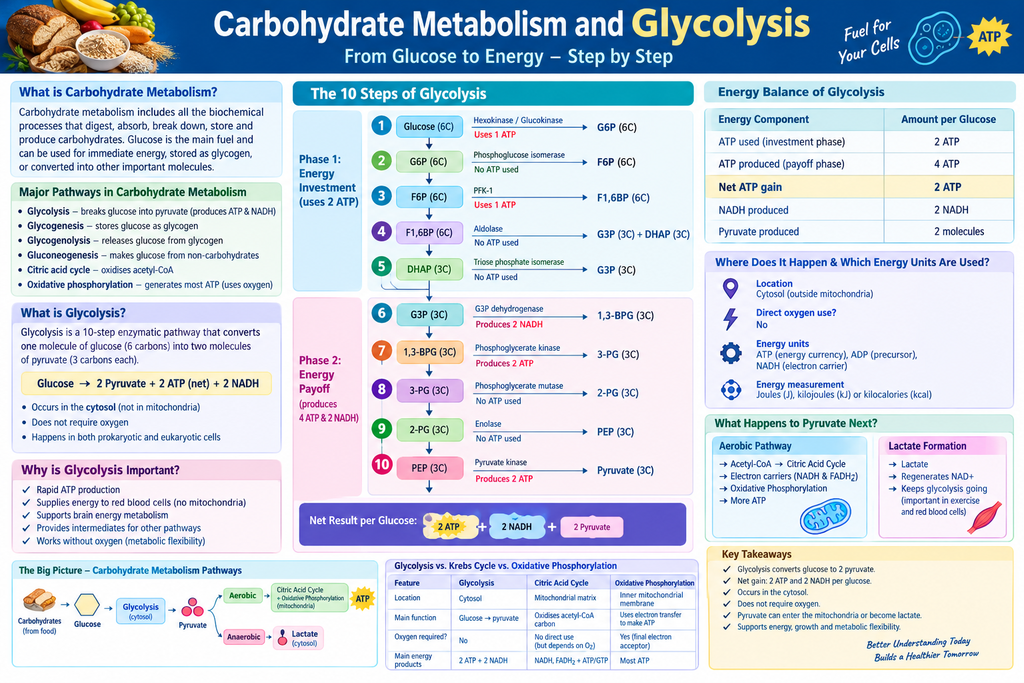
Which Energy Units Are Used in Glycolysis?
To understand cellular energy production, it is important to distinguish between energy-carrying molecules and units used to measure energy.
Three important molecules are ATP, ADP and NADH.
1. ATP: The Cell’s Energy Currency
ATP stands for adenosine triphosphate. It is a molecule that provides usable energy for cellular processes, including muscle contraction, active transport and the synthesis of molecules.
ATP contains three phosphate groups. When ATP is converted to ADP and inorganic phosphate, the reaction can release free energy that is coupled to cellular work.
During glycolysis, ATP is used in steps 1 and 3 and produced in steps 7 and 10.
2. ADP: The Precursor of ATP
ADP stands for adenosine diphosphate. It contains two phosphate groups and can accept another phosphate group to form ATP.
During glycolysis, phosphate transfer from metabolic intermediates to ADP produces ATP directly.
3. NADH: An Electron Carrier
NADH stands for reduced nicotinamide adenine dinucleotide.
It carries high-energy electrons captured during the oxidation of G3P. In cells undergoing aerobic metabolism, these electrons can contribute to ATP production through the mitochondrial electron transport chain.
NADH is not ATP. Instead, it carries electrons that can help the cell generate additional ATP through later processes.
4. Joules and Kilojoules: Units of Energy Measurement
ATP and NADH are molecules, not units of measurement.
Energy itself can be expressed in joules (J), kilojoules (kJ) or kilocalories (kcal).
For example, ATP hydrolysis has a standard biochemical free-energy change of approximately −30.5 kJ/mol. This is a reference value under standard biochemical conditions, not the exact energy released by ATP hydrolysis in every living cell.
Actual cellular free-energy changes depend on the concentrations of ATP, ADP, phosphate and other substances.
Glycolysis Energy Balance: How Much ATP Is Produced?
For every one molecule of glucose, the energy balance is as follows:
| Energy component | Amount per glucose |
|---|---|
| ATP used in the investment phase | 2 ATP |
| ATP produced in the payoff phase | 4 ATP |
| Net ATP gain | 2 ATP |
| NADH produced | 2 NADH |
| Pyruvate produced | 2 molecules |
The calculation is straightforward:
Net ATP = ATP produced − ATP consumed
Net ATP = 4 − 2 = 2 ATP
The two NADH molecules are additional energy carriers. They may support further ATP production during aerobic metabolism, but their contribution is separate from the two ATP produced directly by glycolysis.
What Happens to Pyruvate After Glycolysis?
The fate of pyruvate depends on the cell’s metabolic conditions and its ability to use mitochondrial pathways.
Aerobic Metabolism
When aerobic metabolism is operating, pyruvate is transported into the mitochondrial matrix and converted into acetyl-CoA by the pyruvate dehydrogenase complex.
Acetyl-CoA enters the citric acid cycle, where its carbon is oxidised and electron carriers are produced. These electron carriers then support ATP generation through oxidative phosphorylation.
The mitochondrial electron transport chain uses oxygen as the final electron acceptor during typical aerobic respiration.
Lactate Formation
Pyruvate can also be converted into lactate by lactate dehydrogenase.
During this reaction, NADH is oxidised to NAD+, allowing glycolysis to continue when this route is needed to regenerate NAD+.
Lactate formation is important during intense exercise and in tissues that produce lactate as part of normal metabolism. Mature red blood cells also rely on glycolysis because they lack mitochondria.
Importantly, lactate formation does not mean that the body has completely run out of oxygen. Lactate can be produced even when oxygen is available.
Pyruvate Pathway Flowchart
               GLUCOSE
                  |
                  v
              GLYCOLYSIS
                  |
                  v
               PYRUVATE
                  |
          +-------+-------+
          |               |
          v               v
   AEROBIC PATHWAY    LACTATE FORMATION
          |               |
          v               v
      Acetyl-CoA         Lactate
          |               |
          v               v
   Citric Acid Cycle  NAD+ regenerated
          |
          v
   Electron Carriers
          |
          v
 Oxidative Phosphorylation
          |
          v
     Additional ATP
This diagram simplifies the pathways. Their activity depends on cell type, substrate availability and metabolic conditions.
Glycolysis vs. the Krebs Cycle vs. Oxidative Phosphorylation
These pathways are connected, but each has a different role in energy metabolism.
| Feature | Glycolysis | Citric Acid Cycle | Oxidative Phosphorylation |
|---|---|---|---|
| Location in human cells | Cytosol | Mitochondrial matrix | Inner mitochondrial membrane |
| Main function | Glucose to pyruvate | Oxidises acetyl-CoA-derived carbon | Uses electron transfer and a proton gradient to generate ATP |
| Direct oxygen requirement | No | No direct oxygen use, but sustained activity depends on aerobic metabolism | Oxygen is the final electron acceptor in typical aerobic respiration |
| Main energy products | Net 2 ATP and 2 NADH per glucose | NADH, FADH2 and ATP/GTP | Most ATP produced during aerobic glucose oxidation |
Glycolysis produces a small but important amount of ATP directly. The citric acid cycle generates additional electron carriers, and oxidative phosphorylation produces most of the ATP associated with complete aerobic oxidation of glucose.
Why Is Glycolysis Important?
Glycolysis supports several essential functions in the human body.
1. Rapid ATP production
Glycolysis can supply ATP quickly when cellular energy demand increases, including during intense muscle activity.
2. Energy production in red blood cells
Mature red blood cells lack mitochondria and depend on glycolysis for their ATP supply.
3. Brain energy metabolism
Glucose is an important fuel for the brain under normal dietary conditions.
4. Support for cellular growth
Glycolytic intermediates can be used in biochemical pathways that produce molecules needed for growth and cellular maintenance.
5. Metabolic flexibility
Because glycolysis does not directly require oxygen, it allows cells to generate ATP under conditions in which mitochondrial ATP production is limited or unavailable.
Glycolysis is carefully regulated by enzymes such as hexokinase, phosphofructokinase-1 and pyruvate kinase. Their activity helps the cell balance glucose breakdown with its energy requirements.
Frequently Asked Questions About Glycolysis
Does glycolysis require oxygen?
No. Glycolysis does not directly use oxygen. However, the cell must regenerate NAD+ for glycolysis to continue. This can occur through lactate formation or processes connected to aerobic metabolism.
How many ATP molecules are produced in glycolysis?
Glycolysis produces four ATP molecules but consumes two ATP molecules. The net gain is two ATP molecules per glucose.
Where does glycolysis occur?
Glycolysis occurs in the cytosol, outside the mitochondria.
What is the final product of glycolysis?
The main carbon-containing products are two pyruvate molecules. Glycolysis also produces two net ATP and two NADH molecules per glucose.
What is the difference between ATP and NADH?
ATP directly supplies usable energy for many cellular processes. NADH carries electrons that can support additional ATP production during oxidative phosphorylation.
Is glycolysis the same as cellular respiration?
No. Glycolysis is one pathway within glucose metabolism. Aerobic cellular respiration also involves pyruvate oxidation, the citric acid cycle and oxidative phosphorylation.
Why does glycolysis use ATP before producing it?
The initial ATP investment helps activate glucose and prepare it for splitting. Later reactions recover this investment and produce additional ATP, resulting in a net gain of two ATP molecules.
Conclusion
Carbohydrate metabolism enables the body to use glucose for energy, storage and the synthesis of important biological molecules. Glycolysis is a central pathway because it converts one six-carbon glucose molecule into two three-carbon pyruvate molecules while capturing energy.
The key figures to remember are:
- Two ATP molecules are consumed.
- Four ATP molecules are produced.
- The net gain is two ATP molecules.
- Two NADH molecules are generated.
- Two pyruvate molecules are formed.
Understanding glycolysis provides a foundation for learning the citric acid cycle, oxidative phosphorylation and the broader biochemistry of human metabolism.
At Lab to Life, understanding the science behind everyday nutrition helps connect the foods we eat with the biochemical processes that keep our cells functioning.
References and Recommended Biochemistry Textbooks
The following textbooks are useful resources for students and readers who want to explore carbohydrate metabolism in greater detail.
- Ferrier, D. R. (2017). Lippincott Illustrated Reviews: Biochemistry (7th ed.). Wolters Kluwer, Philadelphia, PA.
- Rodwell, V. W., Bender, D. A., Botham, K. M., Kennelly, P. J., & Weil, P. A. (2015). Harper’s Illustrated Biochemistry (30th ed.). McGraw-Hill Education.
- Nelson, D. L., & Cox, M. M. (2017). Lehninger Principles of Biochemistry (7th ed.). W. H. Freeman.
These references provide textbook-level explanations of glycolysis, glucose metabolism, energy transfer and cellular respiration. Verify the edition and publication details against the specific copy you consult if you use a different edition.
Additional Free Educational Resource
OpenStax. Biology 2e: 7.2 Glycolysis.
This resource provides an accessible introduction to the glycolysis pathway and its energy balance.
[…] you eat carbohydrate-rich foods, digestion breaks many carbohydrates down into glucose. Your cells can use this glucose […]